
H2S Alive and H2S Awareness sound like the same course. They are not. H2S Alive is the full certification required by Energy Safety Canada for oil and gas sites. H2S Awareness is a short theory class that covers only the basics.
Workers in Calgary mix these up all the time. Some book the cheaper Awareness course, show up at the site gate, and get sent home. This guide explains what each course covers, so you pick the right one the first time.
Why H2S Is So Dangerous
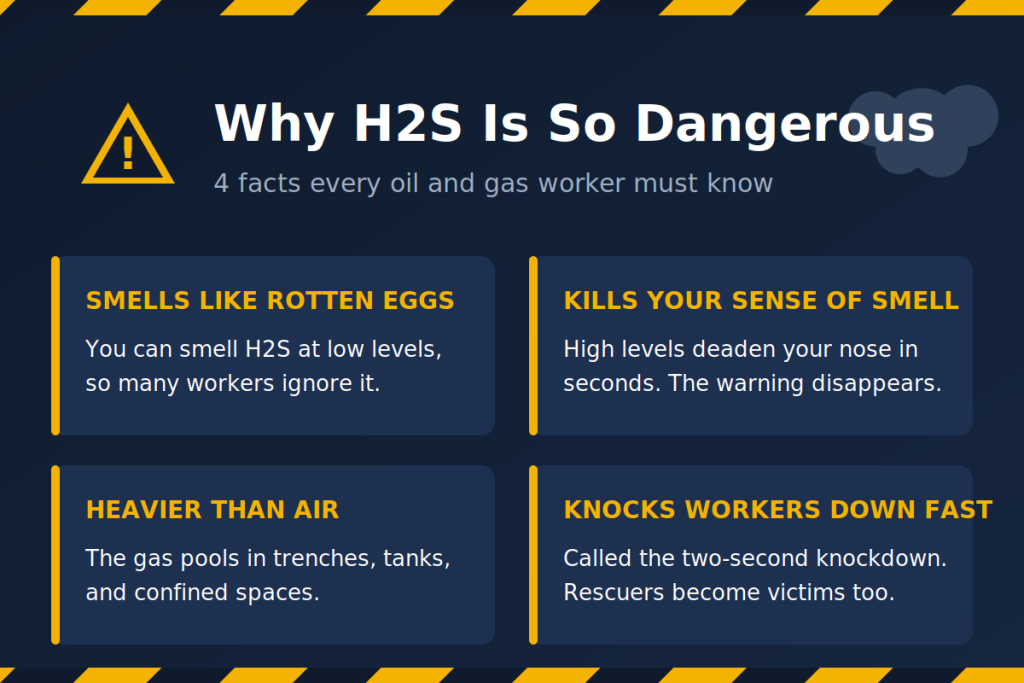
Hydrogen sulfide, or H2S, is a toxic gas. Drilling releases it. So do wastewater plants, pulp mills, mines, and farms. You can smell it at low levels because it stinks like rotten eggs.
Here is the scary part. At high levels, the gas kills your sense of smell in seconds. Your only warning disappears right when the danger peaks. The gas is also heavier than air, so it pools in trenches, tanks, and confined spaces that look safe from above.
OSHA lists H2S as one of the top causes of gas inhalation deaths at work. Many victims are rescuers who rushed in without protection. The Canadian Center for Occupational Health and Safety publishes the full chemical profile, including exposure limits and symptoms.
Field work like this also tests your body in other ways. If you work outdoors past forty, pair your safety tickets with the checkups covered in this guide on the health conversations most Calgary men skip.
What Is H2S Alive?
H2S Alive is the industry-standard certification for Canada’s oil and gas sector. Energy Safety Canada runs the program, and only authorized providers can teach it. Every major operator in Alberta, BC, and Saskatchewan recognizes the ticket.
The course takes one full day, around eight hours. You sit through classroom theory, then you train hands-on. You wear a real breathing apparatus, practice rescue carries and drags, and operate gas monitors and detector tubes.
You also learn a seven-step initial response strategy and apply it in live scenarios. A supervised exam closes the day. Bring a government-issued photo ID because the instructor cannot admit you without it. Pass the exam, and your certificate stays valid for three years.
What Is H2S Awareness?
H2S Awareness is a theory-only course. It runs two to four hours, and many providers deliver it online. You learn what the gas is, where it shows up, what exposure feels like, and how to evacuate.
You never touch breathing gear in this course. You never practice a rescue. The test is an open-book quiz, and your own training provider issues the certificate, not Energy Safety Canada.
That last point matters most. Oil and gas operators want the Energy Safety Canada ticket. An Awareness certificate works for office staff, delivery drivers, and short visits, but it does not open the gate at a sour gas site.
The Key Differences
Here is the full comparison side by side:
| H2S Alive | H2S Awareness | |
| Certifying body | Energy Safety Canada | Training provider |
| Format | Classroom + hands-on drills | Theory only, often online |
| Length | Full day (about 8 hours) | 2 to 4 hours |
| Equipment practice | Breathing apparatus, gas monitors, rescue drags | None |
| Exam | Supervised exam | Open-book quiz |
| Valid for | 3 years | Varies by provider |
| Site access | Accepted across the Canadian oil and gas | Low-risk roles only |
| Cost | Higher | Lower |
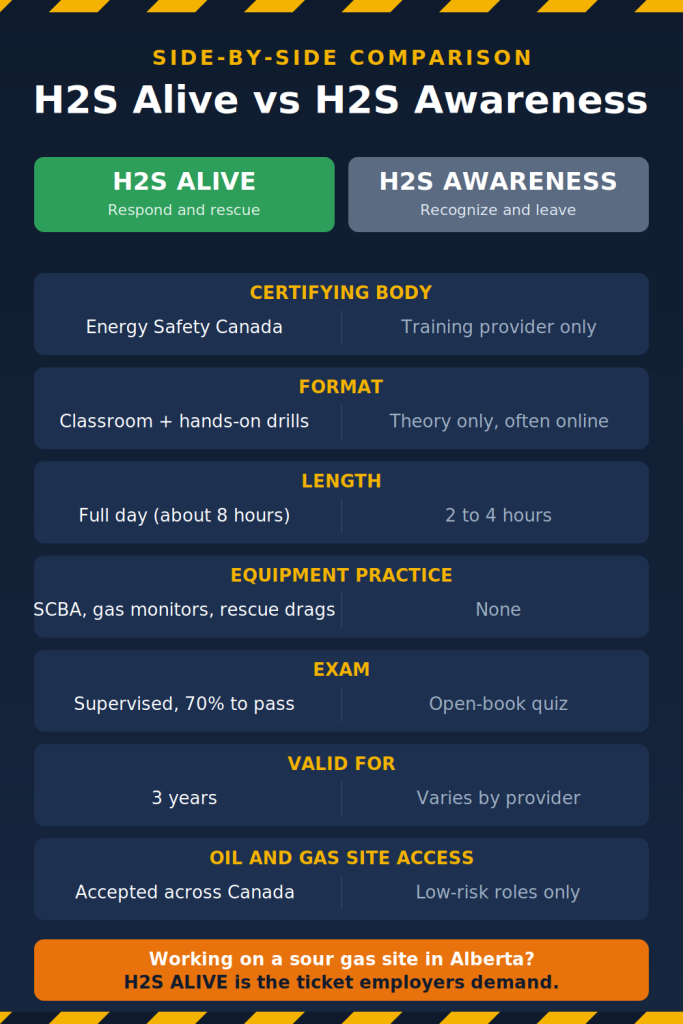
The short version: Alive trains you to respond and rescue. Awareness trains you to recognize and leave.
Which One Do You Need?
Your employer or the site operator sets the rule, so always confirm before you book. The pattern across Alberta stays consistent, though. Rigs, gas plants, pipelines, and well sites almost always demand H2S Alive before you step on location.
Awareness fits people who never enter the hazard zone. Think office staff, couriers, and one-time visitors. Some wastewater and farm jobs also accept it when H2S is a rare risk rather than a daily one.
Not sure which side you fall on? Book H2S Alive. The ticket lasts three years, every operator in Western Canada accepts it, and the higher credential never costs you a job. The lower one might.
How to Get H2S Alive Certified in Calgary
Getting certified takes one day if you plan it right. Follow these steps:
- Confirm the exact requirement with your employer or site operator.
- Book with an Energy Safety Canada-authorized provider. An H2S Alive Calgary course wraps up in a single day, and you get your certificate the same day you pass.
- Bring a government-issued photo ID to the class.
- Come rested and ready to move. The course includes lifting, dragging, and wearing breathing gear.
- Pass the supervised exam and collect your three-year certificate.
- Mark your renewal date. A blended renewal option lets you finish the theory online before a shorter in-person assessment.
Skip step one at your own risk. Workers who guess the requirement often pay for the wrong course and lose a day of wages on top of it.
FAQs
Can I work on a sour gas site with only H2S Awareness?
No. Sour gas sites in Alberta require the H2S Alive certification from Energy Safety Canada. Awareness skips the breathing apparatus and rescue training that these sites demand.
Show up with only an Awareness ticket, and the operator will turn you away at the gate.
How long does an H2S Alive certificate last?
The certificate stays valid for three years from the issue date. After that, you retake the course or complete a blended renewal.
The blended option saves time. You finish the theory online, then attend a shorter in-person assessment.
Do I need to be clean-shaven for the course?
No, you can attend the course with a beard. The mask just seals better on a clean face during the practical drills.
The rule changes on a real work site. If your job requires you to wear a respirator in an emergency, you must shave the area where the mask seals.
Does being tired make H2S more dangerous?
Yes. Spotting a monitor alarm or a faint rotten egg smell depends on staying alert, and long rotations grind that alertness down. Stress shows up in your body before you notice it, so treat rest as part of your safety plan.
A rested worker catches the warning. A burned-out worker walks past it.
How much does H2S Alive cost in Calgary?
Prices vary by provider, but expect a full-day instructor-led course rate. Group and bulk discounts often apply when a crew books together.
The fee covers your training, the exam, and the Energy Safety Canada certificate. Most employers reimburse it, so keep your receipt.